
Michelin sees its unconventional tyre as not only reducing waste but possibly even improving performance.
By Michelin’s estimates, problems with inflation, be it the wrong tyre pressure or unrepairable punctures, knock a whole 20 percent of tyres out of service early – that equals a massive 200 million of them per year.
This is the reason Michelin is trying to take air out of the equation, which they believe they can achieve as soon as 2024 with an airless tyre called the Uptis. They recently demoed these with YouTuber Mr JWW at the wheel of an electric Mini Cooper SE so we could learn more about their behaviour.
How did the demo go?
The Youtuber demoed the tyres on city streets and the feedback was rather positive, claiming that handling of the vehicle appears to be sharper than with traditional tires. According to Michelin, test drivers who have explored the bounds of the Uptis’ performance say its lack of air makes it easy to handle at the limit. JWW also noticed less steering slop on the prototype tires, making airless tires a promising future option for performance cars.
When can we expect to see airless tyres on the road?
Michelin claims to be aiming to have the Uptis tyres on the market by 2024. It is expected the tyres would reach high-value vehicles first and then be developed as time goes along for the everyday vehicle.
Michelin’s Technical and Scientific Communication Director Cyrille Roget told YouTuber Mr JWW that developing the Uptis has taken Michelin a full decade so far. Its end goal is to aim the airless tire at markets that go through large numbers of them, from carmakers to commercial fleets, to even developing countries where punctures are common. Obviously, the Uptis would need sidewalls on rocky roads to keep debris out, and Roget indeed confirmed the production tire could have sidewalls.
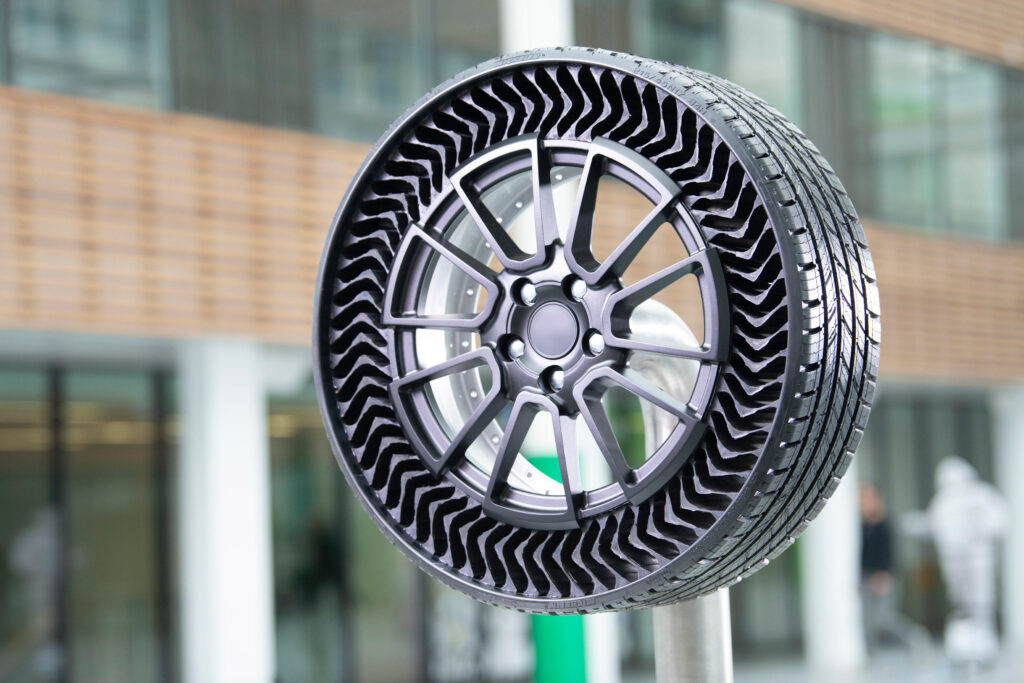
Named for a portmanteau of “Unique Puncture-Proof Tire System,” the Uptis features fiberglass belts under its tread and, in place of air, spring-like spokes that are also reinforced with fiberglass. The tires themselves have been designed not to mount to pre-existing wheels, but ones supplied by Michelin, on which they are balanced at the factory. In theory, they can arrive ready to mount to a car with no special tools or labour needed.